Legos and Deserts
written by Sam Wu
Bahlest Eeble Readings Cycle 18 Fellow
As a child, I loved creating with legos. Instead of following an instruction manual, I’d try to design my own bridges and skyscrapers. The moment I realized music composition was my calling was when I felt that same warm, fuzzy feeling as I had building with legos––the joy of having created something from scratch.
Being an emerging composer comes with a myriad of challenges: financial and career uncertainties, (many many) rejections, professors who proselytize their aesthetic dogmas instead of actually helping students. At times, I wondered if I’d lost the joy of creating. A student I met at a summer festival remarked, “I love hearing the results of my labor, but I hate the labor itself.” A world-renowned composer, whose music I admire, believes “all composers must suffer in order to create good music.” I respectfully disagree.
The Bahlest Eeble Readings helped me to rediscover that warm, fuzzy feeling (thank you thank you thank you, GLFCAM!). The readings were structured as a series of workshops, culminating in a recording session of the four fellows’ compositions. My cohort wrote for a trio: oboist Kyle Bruckmann, bassoonist Jamael Smith, and percussionist Chris Froh. Our first set of workshops were online, where we got to experiment with each instrument individually through composing “seed ideas.” After a few months of composing, we had two workshops during our residency in Boonville, between which we had a day to make revisions. As we completed our works, we were back on Zoom for a brief rehearsal, before our performer-mentors recorded our music.
GLFCAM’s workshopping model encouraged us to explore and ask questions within a supportive, nurturing environment. To paraphrase Gabriela, we were not only figuring out how to write this piece, but also discovering avenues to travel down in our next ten or twenty pieces. Repeated workshops, with time for composing in between, empowered me to explore materials I deliberately could not hear in my mind. Each session with our performer-mentors was a delightful surprise: a combination of things that worked really well, things that didn’t quite work (often, our mentors offered alternative solutions), and things that I could investigate further.
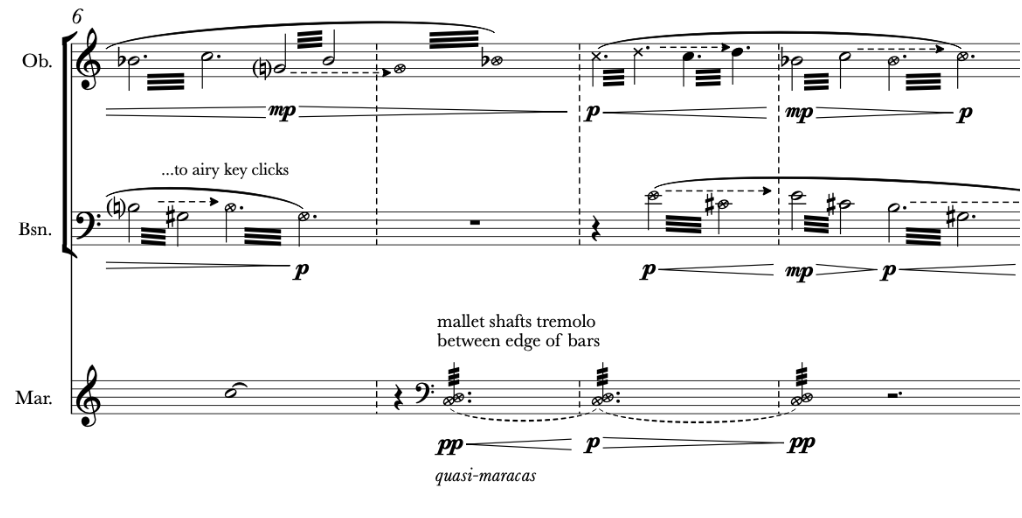
For instance, one miniature in my piece, [alien deserts], transitions between pitch and unpitched tremolos (i.e. just the sound of keyclicks) in the winds. Hearing it workshopped, I wished I could thicken the texture somehow. Chris then suggested an unpitched tremolo analogy on the marimba, by shaking mallet shafts in between marimba keys. The sound is similar to maracas, albeit more delicate and with ghostly shadows of pitch. Just like that, my texture was thickened!
Writing a piece for oboe, bassoon, and percussion trio comes with its fair share of challenges. As someone who plays the violin, and thus is more comfortable with strings, I entered our first workshop with far more questions than answers. Nevertheless, thanks to our kind, generous mentors (Gabriela, Chris, Jamael, and Kyle), I felt no judgment on rough or incomplete musical fragments––instead, I relished being amidst the messy in-betweenness of the creative process.
[alien deserts] is inspired by a roadtrip through the Desert Southwest. I was struck by the stark, otherworldly beauty of the landscapes around me (specifically, Death Valley and Petrified Forest National Parks, and the deserts surrounding Las Vegas). The work is structured as six miniatures, each depicting a different image of the Southwest. The aforementioned keyclicks miniature imitates the rustling of hardy shrubs; a later miniature spotlights the oboe, tracing the silhouette of distant mountain ridges through melodic lines.
Having only lived in cities until my move to Walla Walla, WA, I’ve found profound peace while exploring the great outdoors. Looking ahead, I hope to write more music that engages with our mountains, rivers, forests, and deserts. I think of Mother Nature as a composition teacher, offering infinite wisdom about how we might imagine colors, textures, and atmospheres. In return, we have a duty to protect and advocate for our environment––to remind audiences that Mother Nature is both precious and fragile.

Sam Wu
Sam Wu's music "abounds in delicate colours, wisps of sound and sylvan textures" (Gramophone). Many of his works explore extra-musical themes: architecture and urban planning, climate science, and the search for exoplanets that harbor life.
Selected for an artist residency at Zion National Park, Sam is also the winner of an ASCAP Morton Gould Young Composer Award and the New York Youth Symphony’s Jon Deak First Music Commission.
Sam’s collaborations span five continents: the orchestras of Philadelphia, New Jersey, Minnesota, Sarasota, Melbourne, Tasmania, Macao, and Shanghai, Carnegie Hall, Sydney International Piano Competition, the Lontano, Parker, Argus, ETHEL, and icarus Quartets, conductors Marin Alsop, Osmo Vänskä, and Miguel Harth-Bedoya, and sheng virtuoso Wu Wei.
From Melbourne, Australia, Sam received degrees from Harvard, Juilliard, and Rice. He is on faculty at Whitman College, as their Visiting Assistant Professor in Theory and Composition. Sam's mentors include Gabriela Lena Frank, Anthony Brandt, and Tan Dun.