Why Workshop? A Composer’s Reflection
written by Udi Perlman
Bahlest Eeble Readings Cycle 17 Fellow
One of the top features of the English language, for me, is how you can verb any noun into a verb. I just did it! Simply add “to” before your noun of choice: to hammer, to butter, to email. Or put it where the verb goes: Can you butter my bread? Easy. Other languages do this too (Kannst du mein Brot buttern?), but English verbification—the linguistic term for this phenomenon—is particularly elegant, without any superfluous suffixes.
A verb I encountered often during my Gabriela Lena Frank Creative Academy of Music residency is “to workshop,” as in this wonderfully iterative sentence from an email I received: “These four working days will be when the performers workshop your works to life.” This was new to me. I, of course, knew what a workshop was, but thinking of it as something you do to a piece of music was a fresh perspective. In Hebrew, my mother tongue, the word for workshop is Sadná (סַדְנָה), and interestingly, there is no direct way to turn it into a verb.
Workshopping at GLFCAM means turning the composing process into something less solitary, less stressful, and much more playful. Instead of enduring the creative process alone, workshopping a piece involves presenting it to the musicians before it’s finished and asking for their input. Adding this simple intermediary step in the creative process is like opening the relief valve of a pressure cooker. More than just feedback, it’s a low stakes opportunity to try things on the spot and discover new, better ideas. The performers benefit too, as it makes the creative journey more collaborative while offering them a peek into the composer’s process. It acknowledges both the performers’ expertise and their needs, while also giving them a glimpse of what to expect when the piece is finished, easing uncertainty and stress.
In my piece for harp and violin, Why Did the Child Laugh While Dreaming?, workshopping greatly expanded my gestural and timbral palette. The piece is inspired by observing my newborn son’s facial expressions while he sleeps and imagining his pre-verbal inner world. My vision was to use various sliding effects to evoke the sounds of whimpering and laughter. Ironically, despite contemporary classical music’s supposed emphasis on experimentation, my experience in the field has made me risk-averse. If I had been composing my harp and violin duo outside of GLFCAM, I likely would have played it safe, relying on sounds I’d used before or searching the literature for similar effects, choosing only what felt reliable and practical. All this to avoid the dreaded moment in an often-too-short pre-concert rehearsal when a passage proves unplayable, and it’s too late to fix it.
Workshopping with performer-mentors, violinist Hyeyung Sol Yoon and harpist Jennifer Ellis, under the guidance of Gabriela—both online from my home in Berlin and in person in Boonville, CA—allowed me to explore new ways of realizing my whimper-laughter- glissando concept. Through this process, I incorporated sounds into the piece that I wouldn’t have dared to otherwise—sounds that have now become part of my compositional toolkit.
This idea of a toolkit brings me back to the Hebrew word for workshop, sadná, which comes from sadán (סַדָּן), meaning anvil. This image resonates with me: the musical idea as a bulky piece of metal that you hammer like a blacksmith into shape. It reflects an artisanal approach to composing, one that focuses on craftsmanship over the sanctity of one particular musical idea. It’s as if, through workshopping, you’re saying, “Don’t be so precious about your ideas; it’s just a chunk of metal—hit it hard enough in the right way, and something good will come out.”
Beyond its Hebrew meaning, sadná also has ancient roots in Aramaic, where it signifies foundation or basis. This suggests another dimension to workshopping—not just shaping a musical idea but anchoring it. In other words, it’s not just about sculpting an idea but making it tangible, connected to reality. But beyond shaping the music itself, workshopping also anchors the composer in the reality of collaboration as a form of community building. It transforms composition from a lofty isolated act into an engaged, living dialogue with fellow musicians.
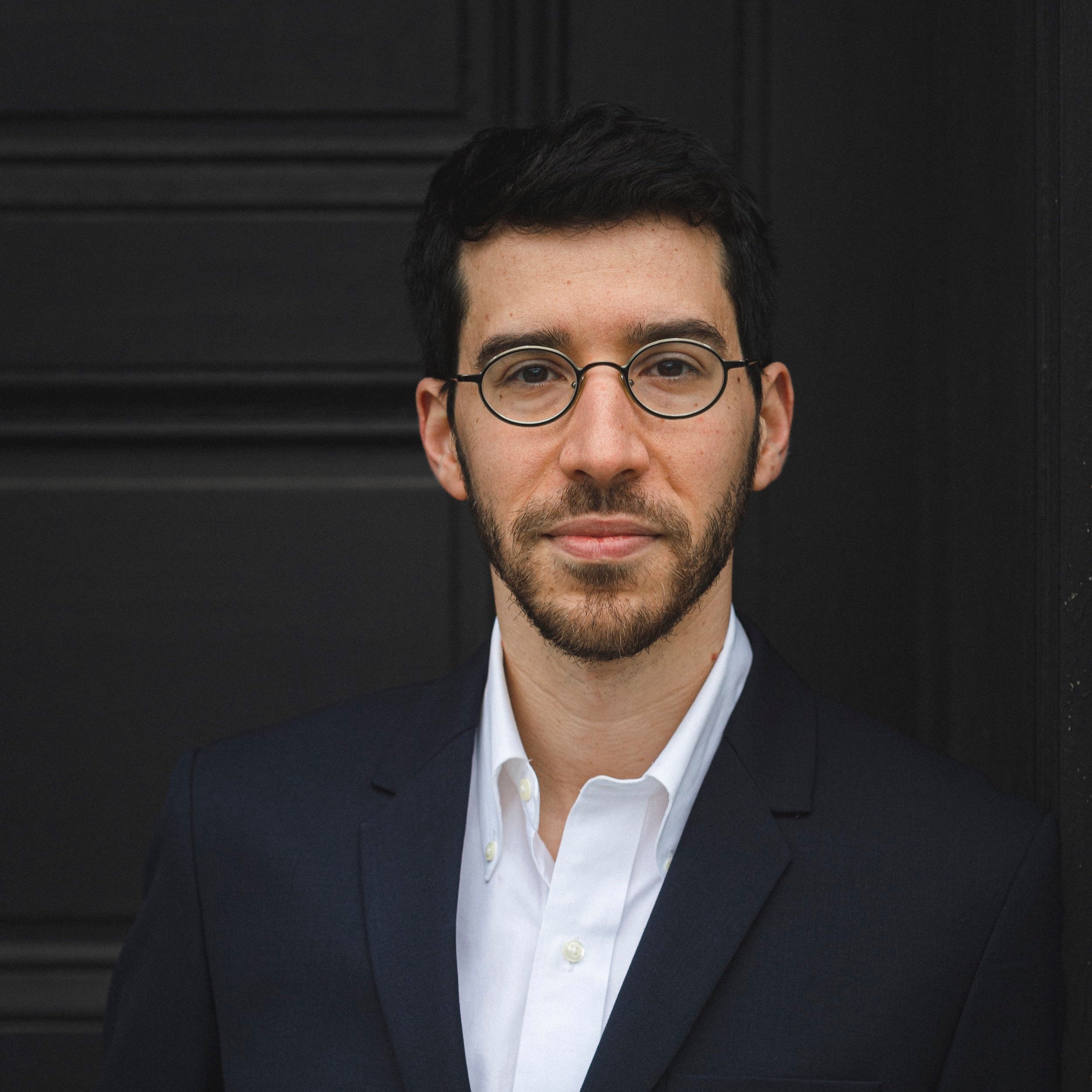
Udi Perlman
Udi Perlman (b. 1990) is an Israeli composer currently based in Berlin, Germany. Described as 'fascinating, surprising, rich, and colorful' (Haaretz), his chamber, choral, and orchestral music has been commissioned and performed in Europe, the United States, and Israel. Perlman is a recipient of the 2024 Pogorzelski-Yankee Award from the American Guild of Organists and the Charles Ives Scholarship from the American Academy of Arts and Letters. He was composer-in-residence at MacDowell, I-Park Foundation, and Herrenhaus Edenkoben, and was a composition fellow at the Aspen Music Festival and School and the Bang on a Can Summer Music Festival at MASS MoCA. Perlman is a DMA candidate in composition at the Yale School of Music, where his doctoral thesis won the 2022 Friedmann Thesis Prize. He holds degrees from the Barenboim-Said Akademie in Berlin (Artist Diploma) and the Jerusalem Academy of Music and Dance (B. Mus. & M.Mus.).