Of Language, Of Sound
written by Oswald Huỳnh
Bahlest Eeble Readings Cycle 17 Fellow
Of Language, Of Sound
To be Vietnamese American is to be a contradiction; a life and identity born from war. Part of the diasporic experience is to exist between disparate cultures. Constantly in a state of translation, many speak a language of the colonizers and a language of the colonized. I grew up speaking Vietnamese (inherited from my parents) and English (learned from watching television), and translator was a role I adopted early in life, taking on duties ranging from parent-teacher conferences to reading court documents for family members. Language became a source of both pride and anxiety, as translation would often fail me in conversation just as much as I failed the languages that were passed down to me.
In Vietnamese, the word tiếng can translate to “language” and “sound.” As a composer, I have been navigating the interplay of these two meanings for the past three years. I began simply with the idea of language as music; specifically, Vietnamese is a tonal language whose rise and fall, highs and lows, cuts and bends become music in my ears. The longer I sat with this concept, the more language itself became a means of expression. Languages are constantly evolving systems that encode the experience of a culture. They are simultaneously modes of communication, collective memory, and manifestations of our emotions. I place English as a language of violence and Vietnamese as a language of grief. In attempting to reconcile the two, I am also searching for what it means to speak a language of empathy.
I. A Language of Violence
Empire and industry. Science, technology, narratology.
Transaction. One language to rule them all.
Billions strong.
— Nam Le
Terra nullius. Nobody’s land. An expression used to justify the occupation of “unclaimed” territory. Violence is masked in the linguistic imperialism of English.
A land explored; a home stolen.
Settlements built; indigenous populations invaded.
Neighborhoods revitalized; communities gentrified.
A people assimilated; a culture erased.
Manifest destiny: displacement, conquest, genocide.
Military history is embedded into English as colloquialisms with each generation passing down these words as positive affirmations. We tell children to knock ‘em dead, crush the competition, stand your ground, rally the troops, soldier on, lead the charge, earn your stripes, take no prisoners… as though life is something to be conquered. A perspective filtered through such brutality begets violence. This language—the one I speak everyday—cuts with its cruelty.
II. A Language of Grief
i don’t know how to speak tenderness in my first language
— Kimberly Nguyễn
Việt kiều. Vietnamese living elsewhere. The burden of leaving a homeland weighs heavy on their shoulders. It’s a part of who I am (whether I like it or not). Locked in a time capsule, much of the Vietnamese diasporic vocabulary I was taught does not carry over across the ocean. Our culture of mourning soaks through our clothes, clinging onto the idea of a country that no longer exists. With this language obsessed with death, I engrave the faces of my dead relatives into my memory. Each day I passed them on the bàn thờ, an altar in their honor. Each year my family gathers for đám giỗ, the anniversary days of each of their passings. And for an evening, past and present celebrate united in grief. The word nhớ means both “to remember” and “to miss.” A word filled with yearning, yet hazy in its meaning. Do we long for a memory more than we truly remember? This language—the one I am losing piece by piece—haunts me in my forgetting.
III. A Language of Empathy
As it is in heaven, so it was on earth.
— Li-Young Lee
For the past three years, my life has been rather nomadic. Traveling from place to place, I never planted my feet for too long. I inevitably crossed paths with a diverse collective of people, from artists to farmers, each with their own goals, motives, and experiences.
On a train to San Francisco, I met first-time mothers struggling to adapt to the new infant in their life. In a commune within the French Alps, I drove through the mountains with a retired nuclear physicist who urged me to simply appreciate the beauty of our natural world. At a residency in Virginia, I exchanged philosophical musings with writers, visual artists, and other composers who were all on their own journeys. With each conversation, I took a piece of their stories with me.
My music often examines intergenerational dynamics and the inheritance of culture and memory, but it is also directly informed by my own identity and lived experience. All these interactions have, consciously or unconsciously, shaped my music into what it is today. In search of a language of empathy, every connection becomes an opportunity for understanding, every composition an attempt at healing. Despite that, this language—the one I strive for—always seems to exist just beyond my threshold.
Works Cited
Le, Nam. “[15. Dire critical].” In 36 Ways of Writing a Vietnamese Poem. Alfred A. Knopf, 2024.
Lee, Li-Young. “My Father, in Heaven, Is Reading Out Loud.” In The City in Which I Love You. BOA Editions, 1990.
Nguyễn, Kimberly. “ngủ ngon.” In Here I Am Burn Me. Write Bloody Publishing, 2022.
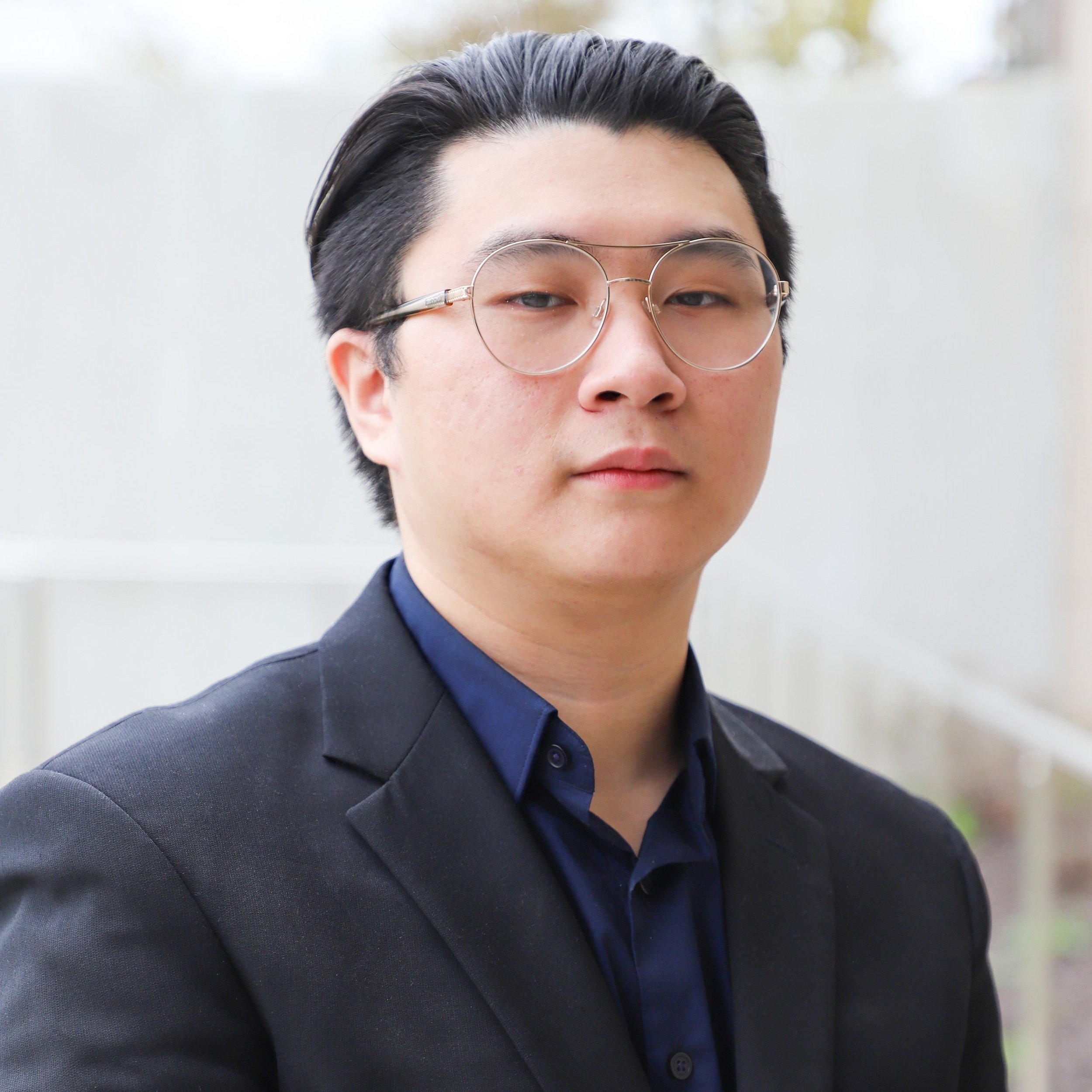
Oswald Huỳnh
Oswald Huỳnh is a Vietnamese American composer whose music navigates Vietnamese aesthetics and tradition, language and translation, and the relationship between heritage and identity. His work is characterized by intricate contrasts of timbre and interweaving textures that are rooted in narrative, culture, and memory. Huỳnh has collaborated with artists like the St. Louis Symphony Orchestra, Alarm Will Sound, American Composers Orchestra, Akropolis Reed Quintet, and Tacet(i) Ensemble. He has received honors from Luigi Nono International Composition Prize, New England Philharmonic, Illinois Philharmonic Orchestra, and Musiqa. Huỳnh holds a BA from Lewis & Clark College and MM from University of Missouri.